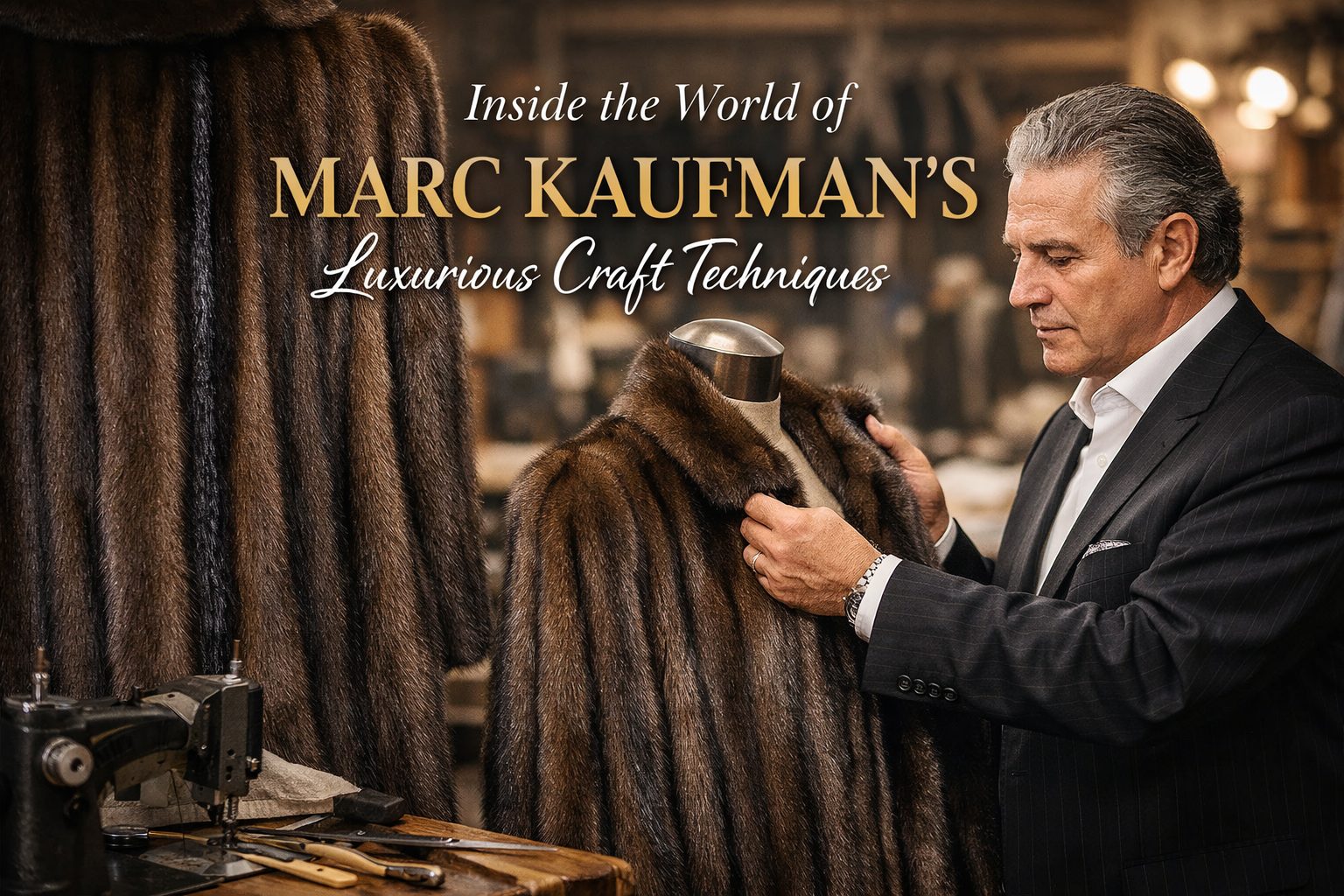
How a Let Out Mink Coat Is Made
Inside the World of Marc Kaufman Furs Luxurious Craft Techniques
At Kaufman Furs, creating a let-out mink coat has never been about mass production.
It has always been about mastery.
As Marc Kaufman often says, a true mink coat should move with the body—not sit on it.
That philosophy is why we continue to use the traditional let-out construction technique,
one of the most labor-intensive and respected craft methods in the world of luxury fashion.
Unlike skin-to-skin mink coats, where whole pelts are stitched together in visible blocks,
this is how we make ours: each pelt is sliced, shifted, and rebuilt into long,
flowing vertical panels that create elegance, flexibility, and exceptional longevity.
Phase 1: Preparation & Matching

Before a single cut is made, every mink pelt must be perfectly synchronized.
A full-length let-out mink coat typically requires 40 to 60 pelts.
- Sorting: Pelts are matched by sex, color tone, density, and nap direction.
- Dressing (Tanning): Each pelt is professionally treated to ensure soft, durable leather.
- Squaring: Pelts are dampened and stretched into uniform rectangular shapes.
Phase 2: The Let-Out Technique

This is where craftsmanship becomes art.
- Diagonal Slicing: Each pelt is fed through a specialized let-out machine
that slices the skin into ultra-thin diagonal strips, kept in exact order. - Shifting: The strips are staggered downward, forming a chevron pattern on the leather side
and transforming a short pelt into a long vertical ribbon. - Precision Sewing: Using a specialized fur sewing machine, the strips are stitched back together.
These micro-seams allow natural flexibility and movement.
The result is a let-out pelt with a continuous dark center line
(known as the grotzen) running from collar to hem—one of the hallmarks of premium mink construction.
Phase 3: Assembly & Blocking

- Panel Assembly: Long let-out pelts are sewn side-by-side to form the back, fronts, and sleeves.
- Blocking (Nailing): Sections are dampened and stretched leather-side up onto large wooden boards
using paper patterns. - Drying: The fur remains on the boards for 24–48 hours, permanently setting the coat’s silhouette.
Phase 4: Finishing Touches

- Trimming excess fur along pattern lines
- Reinforcing edges with starched cotton tape
- Final body and sleeve assembly
- Glazing with steam and heat to restore natural oils and sheen
- Hand-sewn silk or satin lining, with optional interlinings for warmth
Marc Kaufman’s Let-Out Mink vs. Traditional Skin-to-Skin Construction
| Feature | Let-Out Mink (Our Method) | Skin-to-Skin Mink |
|---|---|---|
| Appearance | Seamless vertical flow | Blocked pattern |
| Movement | Fluid, elegant swing | More rigid structure |
| Longevity | Generational quality | Shorter lifespan |
| Remodeling Potential | Excellent | Limited |
Why This Method Still Matters
Because let-out construction distributes stress across hundreds of seams,
the leather flexes naturally instead of cracking. This makes our coats lighter,
longer-lasting, and ideal for future restyling.
Explore our Mink Coats collection to see true let-out craftsmanship.
Protect your investment with professional cold fur storage,
and discover how expert fur remodeling
can transform a vintage coat into a modern silhouette.
“A mink coat should never feel stiff or dated. If it’s made correctly,
it should move, breathe, and live with you.”Skill-Specific Training Periods
Within a traditional furrier workshop, different roles require varying lengths of dedicated “on-the-job” training:Finishers (Liners/Machinists): ~2 years. They focus on the interior silk linings and hand-sewn closures.
Nailers: ~3 years. They learn the critical “blocking” process—using moisture and thousands of staples to stretch fur sections into the precise shape of a pattern.
Cutters: ~3 years. This is the most technical role, involving the slicing and “letting out” of skins without damaging the hair or creating visible seams.
Modern Requirements & Education
While historical furriers learned strictly through family apprenticeships, today’s path often involves a mix of formal education and trade experience:Formal Education: Many modern furriers begin with a 2–4 year degree in Fashion Design or Textiles. This provides a foundation in garment construction and “the eye” for fashion trends.
Specialized Internships: Because fur-working machines (like the Bonis fur sewer) are different from standard sewing machines, most designers spend 1–2 years interning at a heritage fur house to learn the equipment.
Pelt Selection Mastery: It can take 5+ years just to develop the “eye” for pelt matching. A master must be able to look at 100 skins and identify the 40 that have the exact same color depth, hair density, and nap length to ensure a coat looks like a single piece of fabric.
Key Challenges in Training
Irreversibility: Unlike fabric, once you cut a fur skin, you cannot “un-cut” it. Mistakes are extremely expensive, which is why apprenticeship periods are so long.Niche Equipment: You must learn to use circular-needle machines, glazing irons, and steam-tensioning tools that aren’t found in standard tailor shops.
— Marc Kaufman
Get our fur guides first. One tap tells Google to show Marc Kaufman Furs at the top of your own Top Stories, Discover feed and AI Overviews.